OVERGROWN PROPERTY?
WE CAN CLEAR IT.
Forestry Mulching & Overgrown Property Clearing in Newnan, GA
Turn thick brush, unwanted undergrowth, and overgrown wooded areas into more accessible, manageable property. Rick's Yard Spraying provides professional forestry mulching for residential acreage, commercial properties, wooded lots, and neglected land throughout South Metro Atlanta.
- Professional Heavy-Duty Equipment
- Residential & Commercial
- Small Lots to Large Acreage
- Locally Operated
How it works
Professional Forestry Mulching Services
Forestry mulching uses a mulching head, a heavy rotating drum lined with cutting teeth, mounted on a tracked machine. It cuts brush, saplings, and unwanted vegetation and grinds them into mulch right where they stand.
Conventional clearing usually means cutting vegetation down, dragging it into piles, then hauling it away or burning it, often with a dozer or excavator pushing material and roots around. Forestry mulching skips most of those steps. One machine cuts and processes suitable vegetation in place, and the result stays on the ground as a layer of organic material.
That makes it a good fit when the goal is to reclaim, open up, or maintain property rather than strip it to bare dirt. It is selective, too: we can clear the understory and leave the trees you want to keep.
It is not the answer for everything. Not all vegetation can be processed, some ground disturbance is normal with tracked equipment, and mulching does not grade land or pull roots. We will tell you up front when a different approach makes more sense.
Less hauling
Suitable vegetation is processed where it stands, which often reduces the need to pile, load, and haul brush off the property.
Better access
Opening up thick undergrowth makes it possible to walk, drive, survey, and maintain areas that were closed off.
Lighter surface impact
A tracked carrier and a mulching head typically disturb the surface less than some excavation-based clearing. It is not zero disturbance.
On-site processing
Brush, saplings, and selected woody material become a layer of mulch instead of burn piles or debris heaps.
Visibility and upkeep
Sight lines open up around structures, fences, and boundaries, and the property becomes easier to keep up.
Room for what comes next
Clearing undergrowth gives you, your surveyor, or your contractor a clearer look at the ground before planning further improvements.
Scope
What We Can Clear
Typical forestry mulching work around Coweta, Fayette, and nearby counties. Every property gets evaluated before we commit to a scope.
- 01
Thick Brush & Underbrush
Privet, briars, vines, and dense understory cut and processed so you can see and reach the ground again. Larger desirable trees can usually be left standing.
Get a quote for thick brush & underbrush - 02
Overgrown Residential Lots
Back corners and side lots that have been left to grow for years. We focus on the areas you want back and work around structures, fences, and utilities.
Get a quote for overgrown residential lots - 03
Wooded Acreage
Thinning understory and small woody growth across acreage to open it up for walking, viewing, or management, while keeping the timber you want to save.
Get a quote for wooded acreage - 04
Fence Lines & Property Boundaries
Clearing grown-in fence rows and boundary lines so they can be inspected, repaired, surveyed, or replaced.
Get a quote for fence lines & property boundaries - 05
Trails & Access Paths
Cutting walking trails, ATV paths, and equipment access lanes through thick growth. Final path width depends on terrain and what needs to stay.
Get a quote for trails & access paths - 06
Hunting & Recreational Properties
Shooting lanes, food plot edges, stand access, and trail upkeep on recreational land. Plot preparation beyond mulching, like disking or seeding, is a separate step.
Get a quote for hunting & recreational properties - 07
Commercial Property Overgrowth
Overgrown edges, retention areas, back lots, and easements on commercial property that need to be brought back under control.
Get a quote for commercial property overgrowth - 08
Vacant & Neglected Properties
Lots and parcels that have sat untouched. Useful before a sale, a survey, an inspection, or a decision about what to do with the land.
Get a quote for vacant & neglected properties - 09
Invasive Vegetation
Mulching knocks back privet, kudzu-covered brush, and other aggressive growth. Most invasives resprout, so follow-up treatment is usually part of the plan.
Get a quote for invasive vegetation - 10
Storm-Damaged Brush and Vegetation
Broken saplings, tangled brush, and downed small material after a storm. Large downed trees and trees on structures need tree removal, not mulching.
Get a quote for storm-damaged brush and vegetation
Equipment
Heavy-Duty Equipment for Tough Vegetation
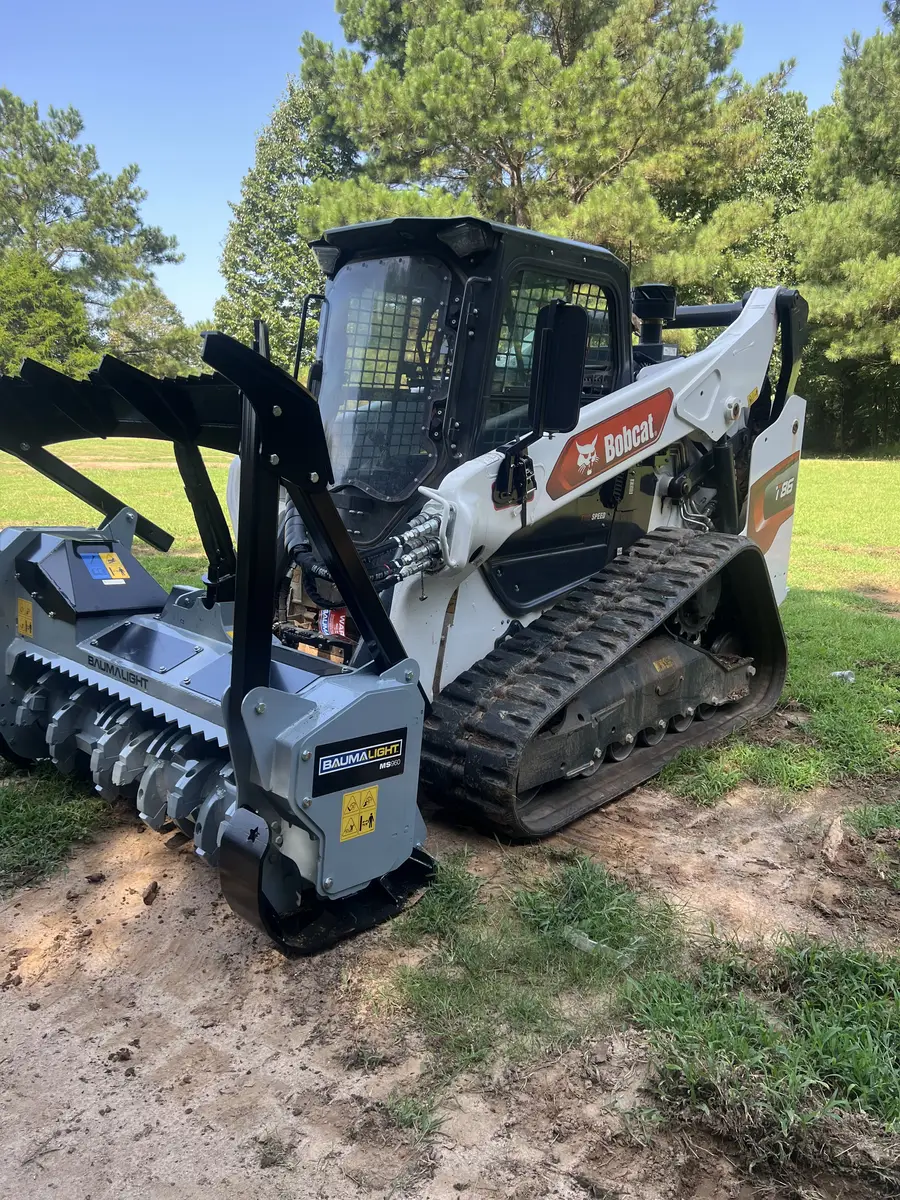
Bobcat T86 Compact Track Loader
A large-frame track loader with the hydraulic flow and weight to run a high-demand mulching head. Rubber tracks spread the machine's weight and help it work on soft ground and uneven terrain where wheeled equipment struggles.
Baumalight MS960 Forestry Mulcher
A drum mulcher built for dense brush and woody vegetation. The manufacturer rates its maximum material capacity at approximately 11.5 inches. That is an equipment specification, not a promise that every tree of that size is suitable for your job.
The actual scope on any property depends on vegetation size and type, slope, soil and moisture conditions, hidden obstacles like rock, fencing, or debris, equipment access, and safety around structures and utilities. We'll talk through these before quoting.
Choosing a method
Forestry Mulching vs. Traditional Clearing
Forestry Mulching
- Processes suitable vegetation on site
- Often reduces hauling requirements
- Leaves processed organic material behind
- Useful for brush, undergrowth, and selected woody vegetation
Traditional Clearing
- May involve tree removal, excavation, root removal, grading, and hauling
- More suitable when the project requires a fully cleared construction surface or extensive ground preparation
Many projects use a bit of both. When your property needs more than mulching, such as tree removal or stump grinding, Rick's can evaluate those services separately so you know what each part involves.
Not sure which approach fits?
Describe the property and what you want to do with it. We'll tell you honestly.
Homeowners
Residential Forestry Mulching
For homeowners with an acre that got away from them or a few wooded acres they finally want to use.
- Reclaim overgrown backyards
- Get back the part of the yard the woods took over, with a defined edge you can maintain.
- Clean up wooded acreage
- Clear the understory so the trees you keep have room and the land is walkable.
- Create walking trails
- Lay out paths through the woods for walking, kids, dogs, or a side-by-side.
- Open fence lines
- Clear grown-in fences so they can be fixed, replaced, or just seen.
- Manage brush near structures
- Pull thick growth back from sheds, barns, outbuildings, and the house where equipment can safely work.
- Restore neglected property
- Inherited land, a new purchase, or a lot that got away from you. Start by seeing what is actually there.
Commercial & trade
Commercial & Contractor Forestry Mulching
- Builders
- Developers
- General contractors
- Property management companies
- HOAs
- Real estate investors
- Commercial landowners
- Agricultural property owners
We handle vegetation management on overgrown parcels, common areas, easements, and back lots; open access for surveyors, inspectors, and crews; and take care of recurring brush maintenance on property that keeps growing back.
For builders and developers, mulching is site preparation support: it clears the understory so you can see the ground and plan the next phase. It does not grade, remove root systems, or deliver a construction-ready pad on its own. Those steps are handled separately.
Next steps
Our Process
- 1
Contact Rick's Yard Spraying
Call 678-850-5475 or send the quote form with your address and a short description.
- 2
Talk through the property
We discuss property size, vegetation type and density, location, access points, and what you want the area to look like when we leave.
- 3
Evaluate and quote
We review the site conditions and give you a customized quote for the agreed scope. Estimates depend on what is actually on the ground.
- 4
Schedule the clearing
We set a date based on weather, ground conditions, and our schedule, and confirm any areas or trees to leave alone.
- 5
Mulch and review
We mulch the suitable vegetation, then walk the completed scope with you and talk through any follow-up work.
Every estimate depends on actual site conditions: vegetation density, acreage, terrain, access, and obstacles. We don't quote blind.
Afterward
What Happens to the Mulch?
Processed vegetation generally stays on the property as a layer of organic material. Here is what to expect.
Mulch thickness varies
Depth depends on how much material was standing. Dense stands leave a heavier layer than light brush.
Decomposition takes time
The layer breaks down gradually over seasons, not weeks.
Stumps and roots may remain
Mulching cuts at or near the surface. Root systems and some stumps stay in the ground.
Regrowth is possible
Many species resprout from roots. Expect some green-up, especially in the first growing season.
Follow-up maintenance
Periodic mowing, re-mulching, or vegetation treatment keeps a cleared area from closing back in.
Not a finished surface
Mulching does not automatically produce a lawn or a construction-ready pad. Those need additional work.
Related services for the next step
- Broader property clearing — Discuss projects that need work beyond mulching suitable vegetation.
- Bush & shrub removal — Root-ball removal for shrubs near the house or beds.
- Stump grinding — Grind remaining stumps below grade after mulching.
- Tree removal — For trees too large or too close to structures to mulch.
- Emergency tree removal (storm) — Storm-downed trees and hazards in the Newnan area.
- Grapple truck service — Loading and hauling debris piles that should leave the site.
- Material delivery — Topsoil, fill, and other materials for the next phase.
- Rock removal & hauling — Loose rock and surface boulders uncovered during clearing.
Service area
Forestry Mulching in Newnan, Senoia & Surrounding Areas
Locally operated in Coweta County, serving Coweta and Fayette counties along with nearby parts of South Fulton, Henry, and Spalding counties.
- NewnanCoweta County
- SenoiaCoweta County
- SharpsburgCoweta County
- Peachtree CityFayette County
- FayettevilleFayette County
Also serving
- Tyrone (Fayette)
- Brooks (Fayette)
- Fairburn (South Fulton)
- Union City (South Fulton)
- McDonough (Henry)
- Hampton (Henry)
- Stockbridge (Henry)
- Griffin (Spalding)
See all forestry mulching service areas. Outside these areas? Call 678-850-5475 and ask.
Questions
Forestry Mulching FAQ
Straight answers. If yours isn't here, call 678-850-5475.
What is forestry mulching?
Forestry mulching uses a mulching head mounted on a tracked machine to cut brush, saplings, and unwanted vegetation and grind it into mulch in place. Instead of cutting, piling, and hauling or burning, the processed material is left on the ground as a layer of organic mulch.
How much does forestry mulching cost in Georgia?
There is no one-size price. Every quote depends on vegetation density and type, acreage, terrain and slope, access to the work area, obstacles such as fences, rocks, debris, or utilities, and what you need the finished area to look like. Call 678-850-5475 or send the form and we will talk through your property and give you a customized quote.
How much acreage can you mulch in a day?
It varies too much to promise a number. Light brush on flat open ground moves much faster than dense hardwood understory on a slope with rocks and stumps. Weather and ground moisture also matter. Once we understand the site, we can give you a realistic expectation for your job.
Can forestry mulching remove small trees?
Yes, saplings and smaller woody trees are a normal part of forestry mulching. The mulcher has a rated maximum material capacity, but whether a particular tree is suitable depends on species, condition, location, and safety. Larger trees, or trees near structures and lines, are usually better handled by tree removal.
Does forestry mulching remove stumps?
Not fully. Mulching cuts vegetation at or near ground level, and root systems stay in the soil. Some small stumps get reduced in the process, but existing larger stumps generally remain. If you need stumps taken below grade, stump grinding is a separate service we offer.
Will forestry mulching damage the ground?
There is always some surface disturbance when tracked equipment works an area, especially on wet ground or slopes. Compared with some excavation-based clearing methods, mulching typically disturbs the soil less because roots are not pulled and the ground is not pushed around. We schedule around wet conditions where we can.
What happens to the mulch afterward?
It stays on the property as a layer of organic material. Thickness depends on how much was standing. Over time it breaks down. It does not turn into a lawn on its own, so if you want grass or another finish, plan on additional work.
Can you clear heavily overgrown property?
Heavily overgrown property is a common reason people call us. Thick brush, vines, and dense understory are what this equipment is built for. Hidden obstacles like old fencing, junk, rock, and steep or wet ground can limit what is practical, so we evaluate the site before we commit to a scope.
Can forestry mulching help prepare a property for future improvements?
It can be a useful first step. Clearing undergrowth gives you and your surveyor, builder, or designer a clear look at the land. Mulching alone does not grade, remove roots, or create a construction-ready surface. When a project needs that, those steps are separate and we can talk through them.
Do you offer forestry mulching near Senoia and Newnan?
Yes. Rick's Yard Spraying is locally operated in Coweta County and provides forestry mulching in Newnan, Senoia, Sharpsburg, and surrounding areas, along with Peachtree City, Fayetteville, and other communities in Fayette County and nearby parts of South Fulton, Henry, and Spalding counties.
Can you mulch around existing trees?
Yes. Selective mulching is one of the main advantages of the method. We clear the brush and understory and leave the trees you want to keep. Before work starts we confirm which trees stay, and we keep a reasonable working distance to avoid damaging trunks and roots.
Will brush grow back after forestry mulching?
Some regrowth is normal because roots stay in the ground, and many species resprout. The mulch layer can slow it down, but it will not stop it. Periodic mowing, a follow-up mulching pass, or vegetation treatment keeps a cleared area open over time.
Free quote
Tell Us About the Property
Send the basics and we'll call to talk through vegetation, access, and what you want done. Prefer the phone? Call now.
Call or text678-850-5475Rick's Yard Spraying · Locally operated · Serving Newnan, Senoia, and South Metro Atlanta · ricksyardspraying@gmail.com